


Provably fair: how every draw in Crypto of Thrones can be checked
Every luck result in Crypto of Thrones comes from drand, a public beacon nobody controls. The round is fixed before it exists, and anyone can recompute the result in a browser.
Every result that depends on luck in Crypto of Thrones, from a box you open to the winners of the daily lottery, comes from a public source of randomness that nobody controls, the game included. This post explains how it works, shows where every proof lives, and teaches you to check a draw yourself in your own browser, in under a minute.
Every draw is also posted, with its proof link, in the Discord channel ✅ provably-fair: https://discord.com/channels/1569816950736166912/1574401931718430771.
What provably fair means here
A draw is provably fair when three things are true:
- Nobody can know the result in advance. Not the player, not the team, not the server.
- Nobody can change the result afterwards. The inputs are written down before the randomness exists.
- Anyone can repeat the calculation from public data and get exactly the same result.
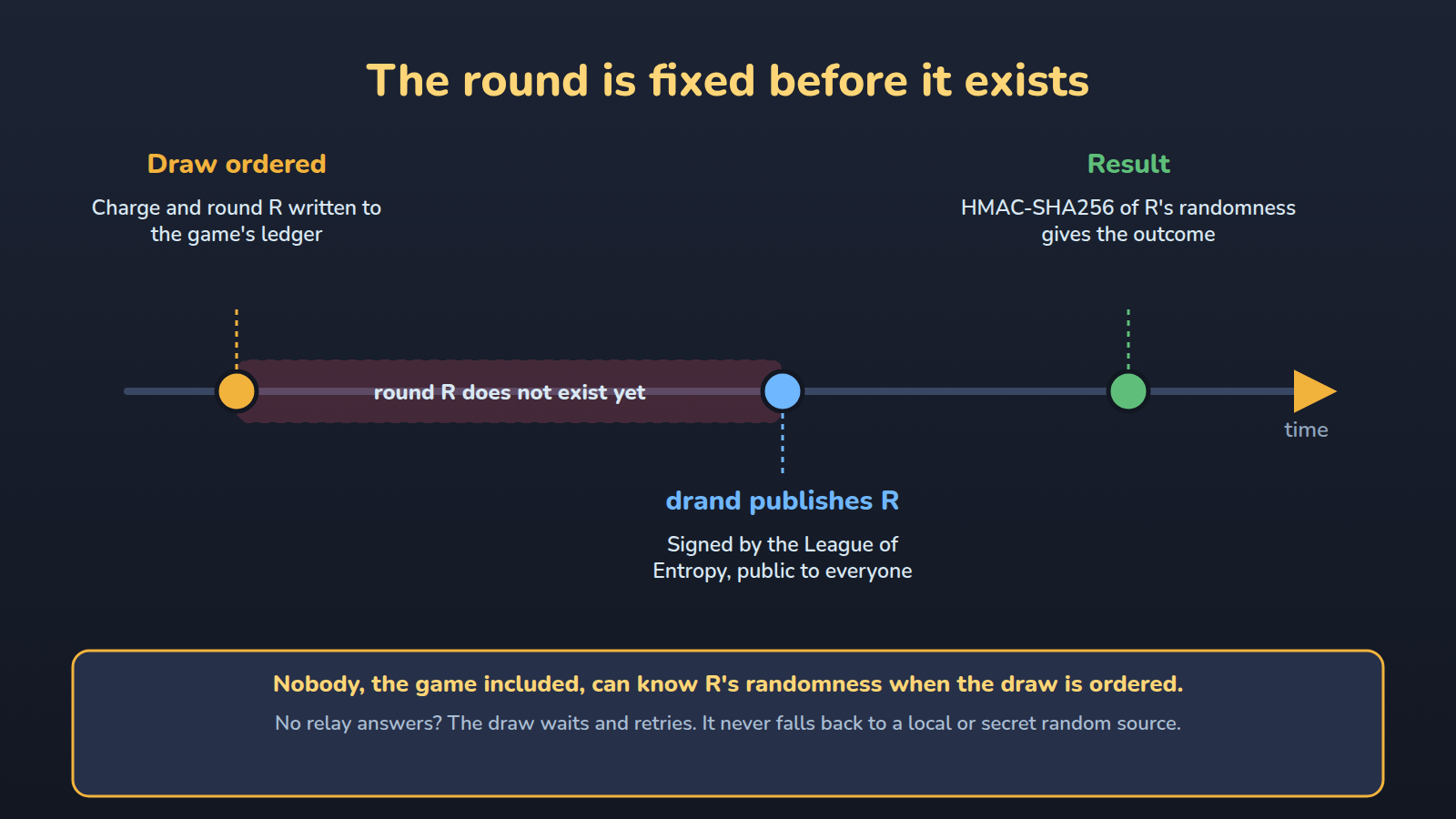
Crypto of Thrones meets all three by taking its randomness from drand and by binding every draw to a drand round that does not exist yet at the moment the draw is ordered.
Where the randomness comes from: drand
drand (https://drand.love) is a public randomness beacon run by the League of Entropy, a group of independent organizations (Cloudflare, Protocol Labs, EPFL, Kudelski Security and others). The game uses its quicknet chain:
- It publishes one round every 3 seconds, numbered in order.
- Each round is a BLS signature over the round number, made jointly by a threshold of the League's nodes. No single member can produce it alone or predict it.
- The round's randomness is the SHA-256 hash of that signature: 64 hexadecimal characters.
- Anyone can check a round against the chain's public key, published at https://drand.cloudflare.com/52db9ba70e0cc0f6eaf7803dd07447a1f5477735fd3f661792ba94600c84e971/info.
The quicknet chain hash is 52db9ba70e0cc0f6eaf7803dd07447a1f5477735fd3f661792ba94600c84e971. The game reads a round from this address, trying the League's relays in this order:
https://drand.cloudflare.com/52db9ba70e0cc0f6eaf7803dd07447a1f5477735fd3f661792ba94600c84e971/public/<round>
https://api.drand.sh/52db9ba70e0cc0f6eaf7803dd07447a1f5477735fd3f661792ba94600c84e971/public/<round>
https://api2.drand.sh/52db9ba70e0cc0f6eaf7803dd07447a1f5477735fd3f661792ba94600c84e971/public/<round>
https://api3.drand.sh/52db9ba70e0cc0f6eaf7803dd07447a1f5477735fd3f661792ba94600c84e971/public/<round>
For example, round 34196212, the one published at 00:00 UTC on 2026-11-23: https://drand.cloudflare.com/52db9ba70e0cc0f6eaf7803dd07447a1f5477735fd3f661792ba94600c84e971/public/34196212. Every relay answers the same round, randomness and signature, because a round never changes once it is out. Before using a round, the game checks its BLS signature against the public key; a round that does not verify is thrown away.
How a draw is decided
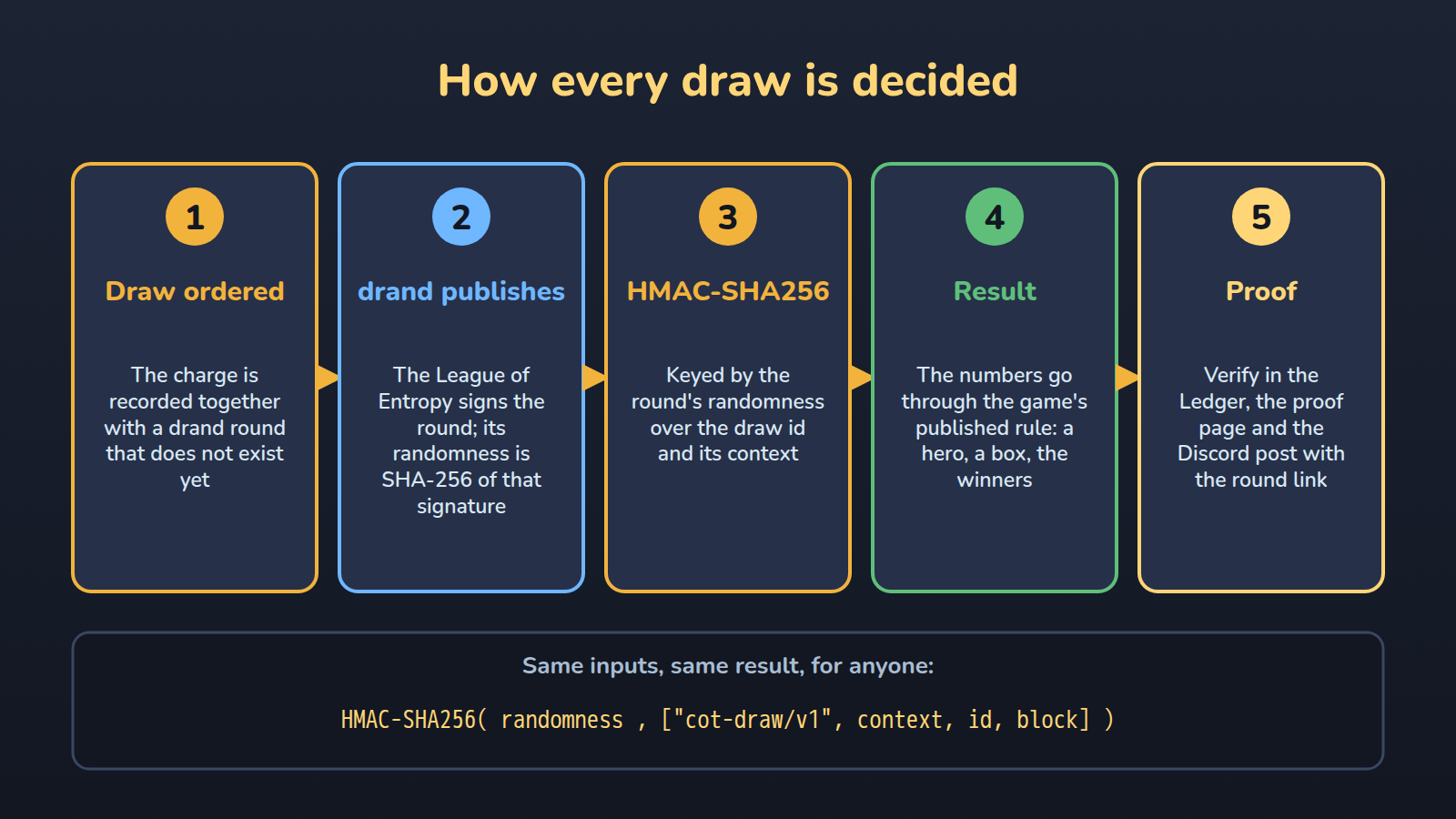
- The draw is ordered. When you open a box, summon a hero, run a fusion, or when a time based draw such as the lottery comes due, the server picks a future drand round and writes it to the game's ledger in the same step as the charge. For an action of yours it is the first round scheduled after the moment of the request (a wait of 0.25 to 3.25 seconds); for a draw tied to a time it is two rounds ahead (3 to 6 seconds).
- drand publishes the round. A few seconds later the round comes out, signed by the League of Entropy.
- The result is computed. The outcome is HMAC-SHA256, keyed by the 32 bytes of the round's randomness, over a message written as a JSON array (UTF-8) of four fields: a fixed domain tag,
context(the kind of draw),id(the draw's own id) andblock(starting at 0). The domain tag iscot-draw/v1. - The numbers become the result. Each 32 byte block gives 8 numbers between 0 and 1 (every 4 bytes read big-endian and divided by 2^32); more blocks give more numbers. The game's published rules turn those numbers into a hero, the contents of a box or a list of winners, exactly as they would any other numbers.
- The proof stays public. The round, the draw id and the result are kept, so the draw can be repeated at any time.
There is no local random fallback. If no relay serves the round, or a round fails its signature check, the draw stays pending and is retried on every relay. The game never falls back to a local or secret random source.
Every draw and where its proof is
Your own draws: boxes, summons, fusions
Every draw of your account is in the in-game Ledger. Each draw entry has a Verify button: it fetches the round again from drand, checks its BLS signature in your browser against the quicknet public key, recomputes the result and confirms that the round was still in the future when the entry was made.
Boxes also get a daily summary in the Discord channel, with the number of openings of the day. Each opening is its own drand draw, checkable in the Ledger of the player who opened it.
Daily lottery
- The drand round of a lottery day is fixed when the first ticket of the day is sold: it is a round after sales close at 00:00 UTC, so it is public long before it exists.
- When sales close, the list of entries (one line per lord, sorted by account, with the number of tickets) is sealed by a SHA-256 hash, still before the round exists.
- Draw inputs: id
lottery-<day>, contextlotteryDraw. The numbers pick the winners one by one, weighted by tickets, from the sealed list.
Royal Draw
- At draw time the entries are frozen and sealed by a hash, bound to a future drand round, and the seal is noted on the realm log before that round exists.
- Draw inputs: id
giveaway-<id>, contextxGiveaway. The numbers pick the winners from the sorted list of entries. - Each Royal Draw has a public proof page at
https://play.cot.gg/d/<id>(the id starts withgw), which opens the result and its proof. The older formhttps://play.cot.gg/draw/<id>still works and redirects there. The raw proof (the public ids of the entries in alphabetical order, the seal, the drand round and beacon, and the winners' X handles) is also served athttps://api.cot.gg/api/giveaway/<id>. - The proof page lists each entry by a random public id, so no entry can be traced back to an account, and names each winner only by the X handle he entered with. The seal still covers the original list, so the page cannot rebuild it from the public ids, and the public Verify button is off for now. The seal hash and the drand round stay public on the page, and each lord who entered can check his own entry in the in-game Ledger while signed in. The public Verify button comes back once the seal covers the public ids.
Fight Hour
Fight Hour uses a commit and reveal on top of drand, so its time stays a surprise until it starts:
- The day before, the server publishes the SHA-256 commitment of a secret daily seed on the realm log: https://api.cot.gg/api/ledger/realm. Each
fightCommitentry shows the day, the drand round and the commitment. - The round of a day is the one published at 00:00 UTC of that day.
- The seed is SHA-256 of three parts joined as raw bytes: the round randomness, the day id and the secret. The day id is SHA-256 of
cot-fight-hour/v2|<day>. The first 4 bytes of the seed pick one of 88 quarter hours: the start is 01:00 UTC plus that many times 15 minutes. - At the start the secret is revealed. Anyone can check that its SHA-256 matches the commitment published the day before and recompute the time.
Here <day> is the number of whole UTC days since 1970-01-01 (2026-11-23 is day 20780).
Raven Call
The Raven Call is a points scoreboard, not a game of luck: places come from summon points, so it has no drand round. When it closes, its final board is sealed by a hash, and the Discord post shows that hash.
Public counts
The public totals and counts of the game's pots are served at https://api.cot.gg/transparency, and the realm's own log, with every commitment, is at https://api.cot.gg/api/ledger/realm.
The ✅ provably-fair channel on Discord
A read-only channel where every big draw is posted with its drand round, its hash and its result, followed by the link to check it:
- The channel: https://discord.com/channels/1569816950736166912/1574401931718430771
- The pinned post that explains how to read it: https://discord.com/channels/1569816950736166912/1574401931718430771/1574403059352608859
- Example posts: https://discord.com/channels/1569816950736166912/1574401931718430771/1574403223912063121 and https://discord.com/channels/1569816950736166912/1574401931718430771/1574403266559738009
Each post says what was drawn, the drand round, the hash and the result. The round links straight to the drand relay, so you never have to take our word for the randomness.
Verify it yourself
You need nothing but a browser.
- Open the drand round URL from the post or from your Ledger entry, for example
https://drand.cloudflare.com/52db9ba70e0cc0f6eaf7803dd07447a1f5477735fd3f661792ba94600c84e971/public/<round>. - Take the
randomnessfield: 64 hexadecimal characters. - Recompute HMAC-SHA256 with the published inputs: key = the randomness, message = the JSON array of the domain tag, the context, the id and the block number.
- Compare the numbers with the published result. Same inputs, same result, for anyone.
The snippet below does steps 1 to 3. Open the browser console (F12, Console tab), paste it, replace the three example values with the ones of the draw you want to check, and press Enter:
// Recomputes block 0 of a Crypto of Thrones draw from a public drand quicknet round.
const round = 34196212;          // example values: use the round, id and context of your draw
const id = 'lottery-20780';
const context = 'lotteryDraw';
const chain = '52db9ba70e0cc0f6eaf7803dd07447a1f5477735fd3f661792ba94600c84e971';
const beacon = await (await fetch('https://drand.cloudflare.com/' + chain + '/public/' + round)).json();
const tag = 'cot-draw/v1';      // the domain tag of every draw
const key = await crypto.subtle.importKey('raw', Uint8Array.from(beacon.randomness.match(/../g), (h) => parseInt(h, 16)), { name: 'HMAC', hash: 'SHA-256' }, false, ['sign']);
const msg = new TextEncoder().encode(JSON.stringify([tag, context, id, 0]));
const block = new Uint8Array(await crypto.subtle.sign('HMAC', key, msg));
const view = new DataView(block.buffer);
// Eight numbers in [0, 1): each 4 bytes, big-endian, divided by 2^32.
console.log(Array.from({ length: 8 }, (_, i) => view.getUint32(i * 4) / 4294967296));
With the example values it prints 0.2793..., 0.0664..., 0.1932... and five more numbers. Change any input, even a single letter of the id, and every number changes: that is why the inputs are fixed and published before the round exists.
To go one step further and check the round itself, drand's documentation at https://drand.love explains how to verify a BLS signature against the chain's public key. The Verify button of the in-game Ledger already does exactly that in your browser.
Read more
- Every wallet, lock and vault of the project, with its proof on the blockchain: https://cot.gg/blog/infrastructure-on-chain
- How the game's actions are logged on the blockchain: https://cot.gg/blog/on-chain-log
Luck in the realm is public. If anyone doubts a draw, open the round and run the numbers.