Maximum alert: a rug dressed as a game
Two coins sold as games collapsed this week: SOLV and NEC. What the chain shows, how to audit any coin yourself, and why Crypto of Thrones is built to be checked.
Warning
Every week a new "game" shows up with a coin attached: cute art, an inflated market value and a lot of promises. Days later the chart turns into a cliff and the buyers are left holding the loss. This has a name: rug. It is a scam with game art on top. Read this before you buy any coin, ours included.
This week two of them fell in front of everyone: SOLV (Sol Village) and NEC (Nectar). We already warned our community on Discord. Here we go further: the numbers, what the blockchain actually shows, a checklist you can run on any coin in a few minutes, and why Crypto of Thrones was built so that you never have to take our word for anything.
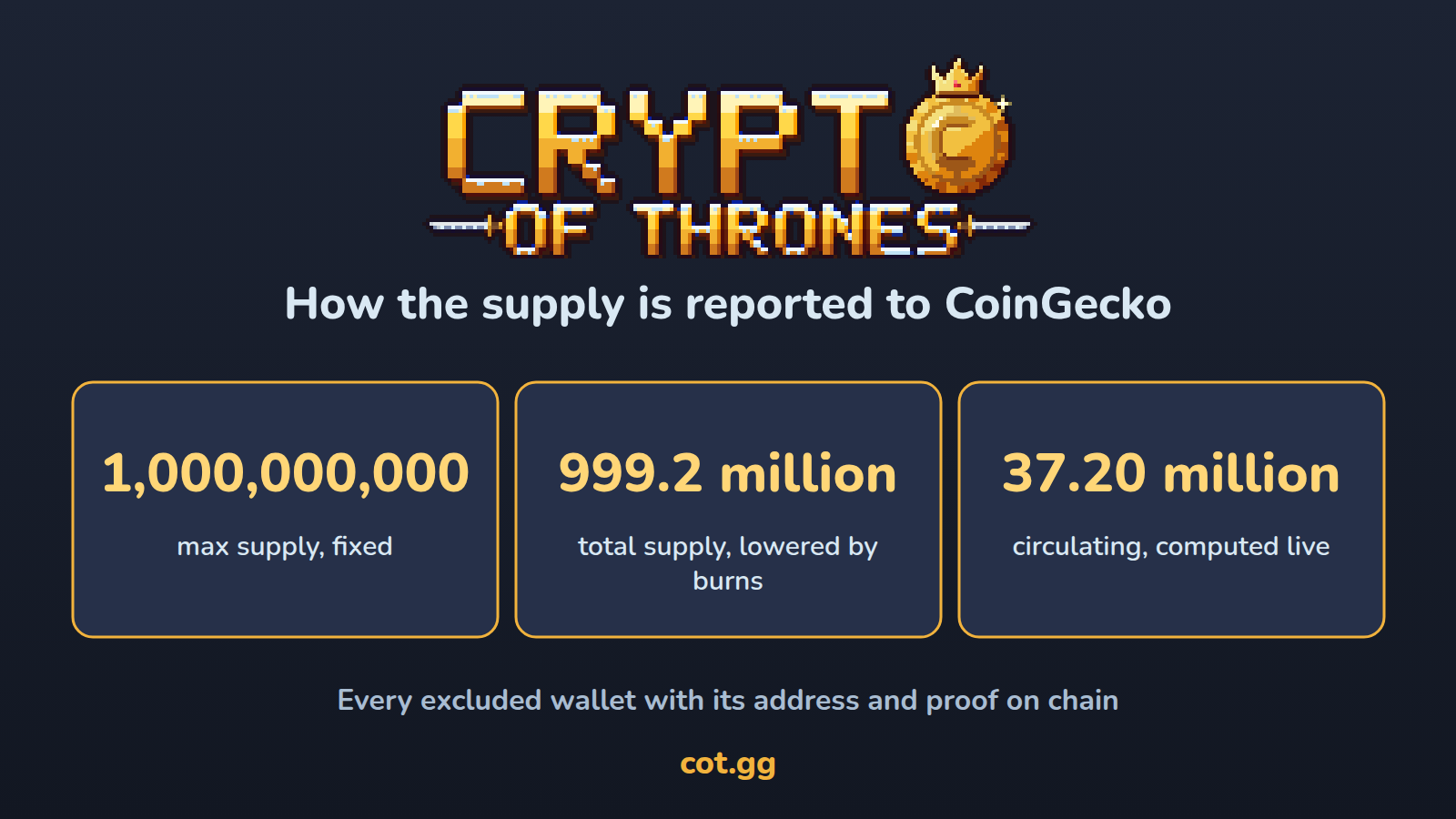
Update (2026-11-25): Crypto of Thrones launched on Solana mainnet on November 20. The mint, the pool, the vaults and the locks described below are live, and every address is on cot.gg/transparency. Withdrawals are open on mainnet, and the Ledger roots are anchored on Solana mainnet. No external audit has been performed yet: it is the next step, tracked on Security and audits. The dollar figures of the two coins below were taken out; the percentages and the on-chain facts are the ones read on November 19.
What a rug dressed as a game looks like
The script is almost always the same:
- A coin made from a ready-made template. No contract written by the team, no plan for the supply. Anyone can create one in minutes.
- A game skin. Pretty art, a trailer, a roadmap full of features. Often there is no playable game at all, or only a demo.
- A pumped chart. Early buyers, bots and wallets close to the creator push the price up, and the market value starts to look serious.
- The dump. Whoever holds a large share of the supply sells into the pool, the price falls 90% or more in hours, and liquidity dries up.
- Silence. The channels go quiet, the "game" never ships, and the people who paid the bill are the players.
Note
A high market value, a listing on an exchange and good art prove nothing. Anyone can create a coin and a pool in minutes, without knowing how to code. What proves something is what is on the blockchain, and you can check that yourself.
The two cases of this week
Numbers below were read on November 19, 2026, at 14:40 UTC from public market data, and the holder structure comes from an on-chain review done the same morning (10:45 to 11:20 UTC). Percentages of supply are snapshots: they change with every block.
SOLV (Sol Village)
| Item | Value |
|---|---|
| Mint | 5wQn3vMRohsB5ep6jRnu6MoHFGEsmy9oXP8WRJz4pump |
| Drop in 24 h | about 98% |
| Distance from the peak | about 99% below the high of November 16 |
| Liquidity | a few thousand dollars |
| Market value | a few thousand dollars |
| Mint and freeze | both off |
What the chain shows:
- The largest holder, with 79.32% of the supply, is the liquidity pool itself (pool account). That is normal: in most small coins the pool is number one.
- The 9 largest holders outside the pool add up to 10.14% of the supply.
- The second largest (2.68%) is a lock escrow whose beneficiary is the coin's creator, set to release on February 6, 2027. It has not been touched.
- The other 8 are plain wallets, with no lock and no explanation, and together hold 7.47%.
- The price fell by about 97% between the start of November 19 and the reading at 14:40 UTC the same day.
NEC (Nectar)
| Item | Value |
|---|---|
| Mint | BLM4DVkDAKXxi9YJDWPyPsRC9Ao2bqhDU3A8pYVwgHYw |
| Drop on November 17 | about 90% in a single day, on the biggest volume of the week |
| Distance from the peak | about 92% below the high of November 7 |
| Liquidity | a few thousand dollars |
| Market value | a few thousand dollars |
| Mint and freeze | both off, and it still collapsed |
What the chain shows:
- The largest holder is not the pool. It is a plain wallet,
67w9p5pxSgCS6qoLJo8DjcxEDyKrMuz5FehWgmtsE4W2, holding 52.07% of the supply. It has a private key, signs its own transactions, and is not a lock or vesting contract of any kind. - Its very first deposit, on November 2, was 277.35 million NEC sent by the coin's creator (transaction), who then closed his own token account. That is why the creator now shows zero NEC.
- On November 17, the day of the crash, this wallet made 1,059 outflows, none of them through the pool: 1,056 burns totaling about 3.0 million NEC and 3 transfers to third party wallets (for example this one of 1,000,000 NEC).
- The second largest holder, with 45.80%, is the liquidity pool (pool account).
Note
Be precise about what this proves. The data does not show who sold on November 17, and nothing on-chain names the owner of the 52% wallet. What it does show is enough to stay away: more than half of the supply sits in one unlocked wallet, fed by the creator, that can move everything at any moment, and the price lost about 90% in one day. That structure, and that chart, is what a rug looks like.
Why a coin minted on a one-click launchpad is a red flag
A coin minted on a one-click launchpad: the sign nobody wants to see. SOLV's address ends in "pump": it was born on a public one-click coin launchpad. You can spot these coins in seconds: the address ends in "pump" and the icon shows the pill. When that happens, the dev wrote no contract at all. He filled out a form. And that says a lot:
- Ready-made template, mass-produced. Thousands of identical coins a day. No coding or blockchain knowledge needed. Lazy, inexperienced devs love it.
- The dev controls nothing that matters. There is no team share and no lock. 100% of the supply is born on the sale curve. The team only owns what it buys, like anyone else, and can sell whenever it wants.
- The creator can buy in the very instant of creation, even with several wallets, and nothing forces him to show it.
- Bots and snipers get there before you. The coin opens to everyone in the same second. Bots buy in the first blocks and sell on the first pump, on top of whoever came later.
- No vault, no plan. Without locks or public vaults, nothing holds the supply in place once the hype fades.
- Doomed to fail. No lock, no vault, no plan: the ending is usually the same as the two cases above.
Note
On a coin like this, "mint off" and "freeze off" are expected and tell you very little. NEC had both off and still lost about 90% in a day. What matters is how a coin is born and who holds the supply.
Crypto of Thrones is the opposite. The game's coin is ours: created and configured by the team, not a launchpad form. The supply split, the locks and the vaults were designed by us, and every address is published for you to check on your own at cot.gg/transparency.
A DEX listing proves nothing
Being listed on a DEX proves nothing. Anyone can create a coin and a pool in minutes, without knowing how to code. A high market value and pretty art prove nothing either. What proves it is what is on the blockchain, and you can check that on your own, with the steps below.
Audit any coin yourself, step by step
Before buying any coin, ours included, take five minutes:
- Run a scanner. Paste the contract address into dexanalyzer.org and read the score and every warning, not just the color.
- Mint: can the creator still create more coins? If yes, he can dilute yours whenever he wants.
- Freeze: can someone lock the coin inside your wallet? If yes, run.
- Liquidity: was it burned or locked? Unlocked liquidity can be pulled all at once.
- Who holds the supply: the largest holder is usually the liquidity pool itself. Look at who comes after it. Are the big holders public locks and vaults, with a deadline and an address published by the project? Or loose wallets with no explanation, like NEC's 52%? Unexplained concentration is a red flag.
- Is the dev selling? New wallets tied to the creator that buy right at the start and sell later are another red flag. Follow the creator's first transfers on an explorer such as Solscan.
- The whole project: does the game exist and can you play it today? Is the code public? Are the vaults public? Can every number be checked by you, without asking the team?
Warning
If any answer above is "no" or "I can't tell", treat the coin as a rug until proven otherwise.
Why Crypto of Thrones is different
Nothing here is "trust me". Every layer of Crypto of Thrones was designed so that you can check it yourself, with public data and public code. Here is each protection, what it does and where to verify it. The full status of each item, including what is live today and what is ready for launch, is on Security and audits.
The coin and the liquidity
Our coin is ours. It is created and configured by the team, not a launchpad form. At launch the mint authority is revoked, so nobody, not even the team, can create new coins. There is no freeze authority, so nobody can lock the coin in your wallet. The launch pool is our own liquidity pool, with the LP tokens burned in the same creation sequence, so nobody can pull the liquidity. This sequence was rehearsed on the test network.
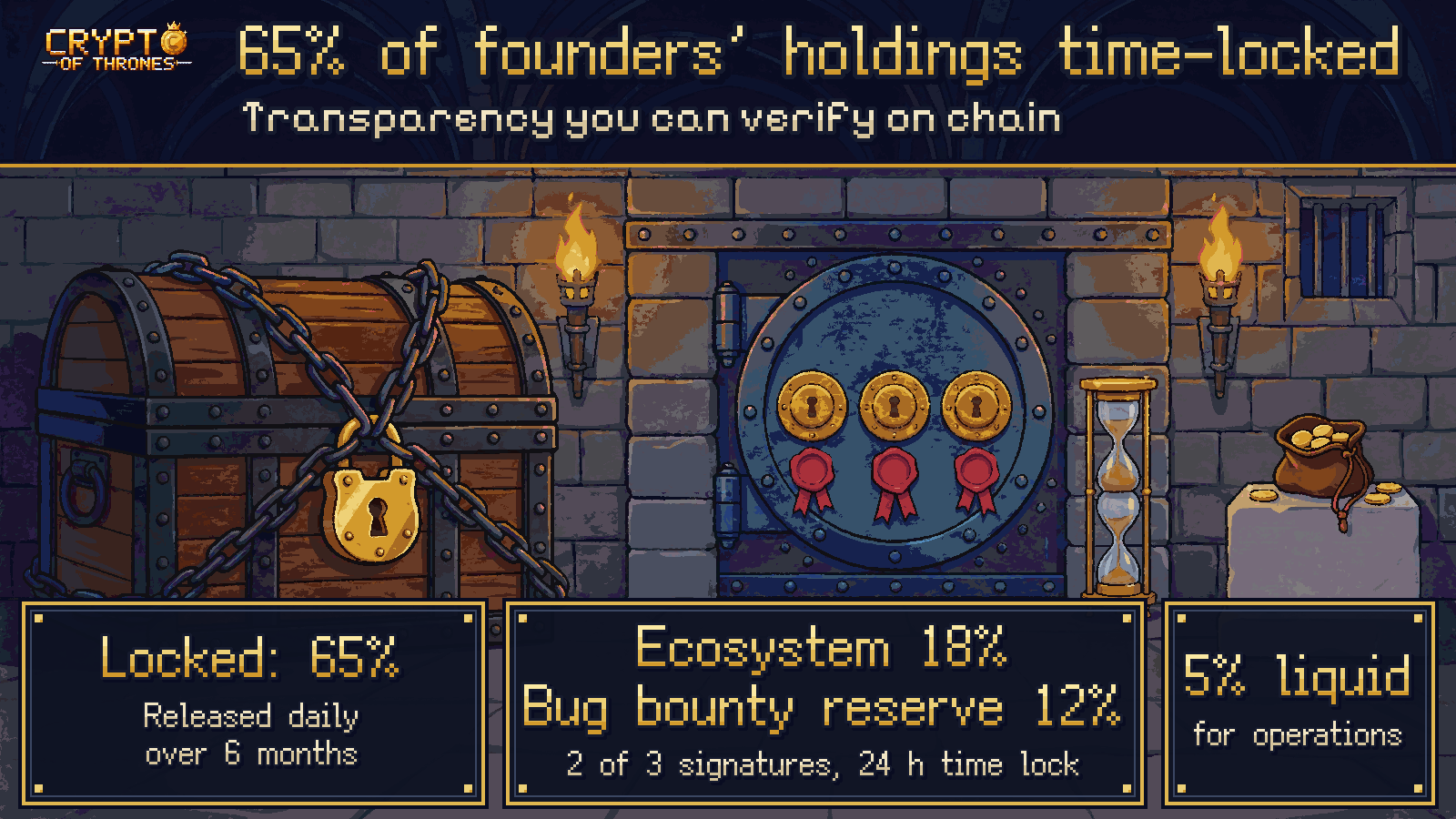
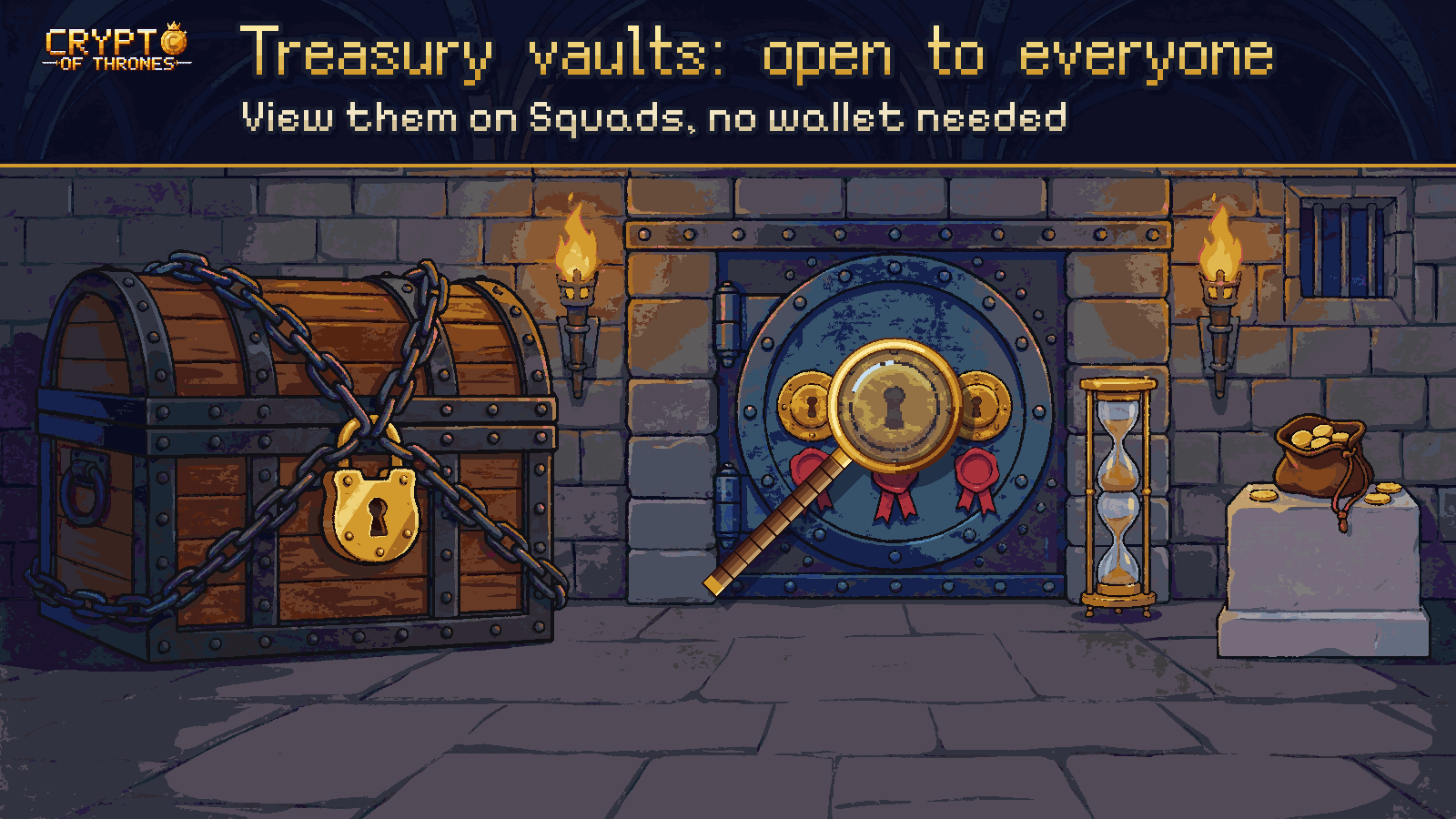
The supply is held in public, not in loose wallets. The Reward Pool, the stabilization reserve and the treasury live in 2 of 3 multisig vaults, released by locks over time. Team coins sit in a lock that cannot be cancelled. Every address is public: the mint, the pool, the vaults, the locks and the game server wallet, each with its proof link, on cot.gg/transparency. Official links will only ever be posted by the team on our site and in our official channels. Never trust a contract address sent by DM or posted by anyone else.
Draws nobody controls: drand, commit then reveal
Every draw that gives or takes value uses drand, the public randomness beacon of the League of Entropy, a group of independent organizations that includes Cloudflare, Protocol Labs and EPFL.
- Commit. When you act, the game charges the action and locks it to a future drand round, one that does not exist yet. That lock is written to your Ledger in the same step.
- Wait. The round is published a few seconds later, signed by the League's nodes.
- Reveal. The result is computed from that round with the game's published rule. Same inputs, same result, always.
- Verify. The Verify button reruns the draw in your browser and checks the round's signature. Anyone can fetch the same round from the public drand API.
Since the round did not exist when the draw was locked, nobody, not even the team, can know or pick the result.
A hash-chained Ledger, sealed on Solana
Every spend and every gain becomes a Ledger entry with a hash chained to the previous one. Nothing can disappear, be inserted or change in the middle of the history without breaking the chain. On a regular basis, with no fixed clock time, the entries of the whole realm are sealed into a Merkle root, and that root is anchored on Solana. This works today in the live game, on Solana mainnet: under Verify, each entry shows when its root was anchored.
The Transparency panel
The eye button in the game opens the Transparency panel: what came into and went out of each pot, what was spent, paid, withdrawn and burned, the latest sealed Ledger root, and, for each luck system, the published odds side by side with the real results. Every line is a real entry with its signature.
Public code for audit: verify it yourself
The code that decides every draw, every Ledger entry and the on-chain payout rules is public at github.com/Crypto-of-Thrones/core. It includes a verifier that checks any account against the public Ledger and the Solana anchors, without trusting our server:
node tools/verify/verify.mjs <account> --base https://api.cot.gg --mainnet --rpc https://api.mainnet-beta.solana.comIt downloads the account's public Ledger, checks the hash chain, the Merkle proof of every entry, the anchoring transaction on Solana and every drand round, then reruns the rule of each entry. Entries that name a wallet appear shortened on the public Ledger, so the verifier shows them as hidden; their owner checks them in full in the in-game Statement. No external audit has been performed yet; it is the next step after the launch and is tracked on Security and audits. Until then, the code is public so that anyone can audit it.
Authoritative server and capped withdrawals
Balances and draws never live in the browser. The game server owns every balance, reward and roll; the client can only ask, and every request is checked. There are limits per action, a risk review that can hold a suspicious withdrawal for a human look (never an automatic ban), and every approved withdrawal gets a voucher from a separate signing service, with a ceiling per withdrawal and per day. Withdrawals were turned on in the beta on November 14 and are open on Solana mainnet since the launch.
Wallet-only sign in
You sign in only with your wallet, on the official address, with a signature that moves no funds. There is no password to leak. The team will never ask for your secret phrase. Anyone who does is a scammer.
The Founders Ark in the open
The Founders Ark vault is a Squads multisig, 2 of 3 signers, with a 24 h time lock: no single person can move it, and every approved move still waits 24 hours before it can run. Every Ark sale is public, in the #ark-sales channel on Discord and in the Audit tab, with its hash. Every Ark also gives a soulbound founder certificate on-chain, bound to the wallet that paid.
The game exists, and you can play it today
This is the simplest test of all, and the one rugs always fail: Crypto of Thrones is playable right now at play.cot.gg. Hunts, summons, draws, the Ledger, Verify and the Transparency panel are all live. The coin launched on top of a game that already runs.
Note
A serious project shows itself in full: the game, the code, the vaults, the locks and every number. If any of that is hidden, ask why.
Don't trust, verify
Use the checklist above on every coin you see, and use it on us too. Get our addresses and channels only from cot.gg/official-links, join the community on Discord, and read the live status of every protection on Security and audits.
Don't trust. Verify.